Tuesday, January 14, 2014

Captain William Bruce Overstreet, 1921-2013.

Children rarely concern themselves with the lives of adults. When you're a kid, the grown-ups around you seem to live in a kind of bubble where they don't exist except for when you see them. Remember the first time you saw a teacher outside of school? It was strange. Didn't your teacher just....live at school all the time or something?

It's no different with the adults in our families. So when Mom would pack up me and my brother and take us down to Roanoke to see our great Uncle Bill and great Aunt Nita, I never spent a moment thinking about the lives they led before knowing us. We would sit in their living room telling stories at Christmas, or see them at Aunt Melvene's cabin in Goshen, Virginia, or wander around Clifton Forge together, the small town in Virginia where Uncle Bill was raised. Bill was always there...usually seated in his favorite chair, with his pipe in hand, laughing and chatting.

But I didn't know he was a hero.

We bat around the word "hero" a lot. And don't get me wrong--people like teachers, firefighters, policemen, and heck, even the person who gives up a seat on the metro for a pregnant lady, are deserving of the title. But until this past weekend, I had no idea that my great Uncle Bill--the quiet man with the pipe and twinkle in his eye--was an honest to god war hero.

At the Greenbrier Air Show in 2012.


William Bruce Overstreet, Jr., born on April 10, 1921, passed away on Sunday afternoon, December 29, 2013.

"He served as a Captain in the U.S. Army Air Force during World War II. Bill was a highly decorated combat veteran with the 357th Fighter Group.

After the war, he began his career in Roanoke as a CPA in his own practice. Bill was active in several charitable organizations, both locally and nationally. He was a member of The Businessmen’s Club and the Big Lick Breakfast Club, whose members will be honorary pallbearers at the grave. He will truly be remembered as an honorable and generous individual to his family and country. Bill was a native of Clifton Forge, the son of the late William B. and Gertrude Taylor Overstreet. He was also preceded in death by his wife, Nita Brackens Overstreet; and two sisters, Bernice Overstreet Meiselman, of Alexandria, and Melvene Overstreet Marks, of Rocky Mount, NC."

The above is from Bill's official obituary. But it's just the tip of the iceberg. "Highly decorated combat veteran?" Oh, honey. Let me fill you in.

Bill Overstreet flew over 100 combat missions as part of the 357th Fighter Group, a combat unit of the Army Air Forces during WWII.  Alongside Chuck Yeager and Bud Anderson, Uncle Bill flew a P-51C Mustang ("The Berlin Express") from a small airfield in Leiston, England to France the defend the skies of Paris from Nazi aircraft. He also flew missions to Germany, Eastern Europe, and Italy.

His war service sounds more like a movie: he was shot down/crashed several times, survived a broken oxygen line that caused him to pass out in the cockpit, and was even captured by the Germans and managed to escape.

The Virginia Museum of Transportation features Uncle Bill in its Wings Over Virginia Aviation Gallery with an exhibit called Flight Talk, that includes video of Bill discussing his more dramatic wartime moments. Regarding his capture and escape, he relates that he was placed in the back of a vehicle with two Nazi Stormtroopers in the front seat. A large wrench had been left in the back and he was able to hit the Nazis on the head and take the vehicle into the French countryside. He hid out in the woods surrounding a town until he was able to find a clergyman who could help him contact the French Resistance and get back to his base.

To hear Bill tell it, it was just another day at the office.

But his most memorable moment was in the Spring of 1944 when he pursued a German aircraft under the Eifell Tower during a dogfight.  According to the Roanoke Times, "Overstreet’s most famous flight came while in solo pursuit of a German Messerschmitt Bf 109G flying into Nazi-occupied Paris. He maneuvered his plane beneath the arches of the Eiffel Tower, re-igniting the spirit of the French Resistance troops on the ground." Bill's pursuit and destruction of the Nazi plane over Paris was a seminal moment for the French, and inspired a three day uprising in the Nazi-held city.

A painting of Bill's "The Berlin Express" flying under the Eiffel Tower in pursuit of a Nazi plane, by Len Krenzler.


 In the cockpit!


In December 2009, Bill was awarded the French Legion of Honor at the National D-Day Memorial in Bedford County, Virginia by His Excellency Pierre Vimont, the Ambassador of France to the United States of America. It is the highest honor bestowed by the French nation and gave Bill the title of "Chevalier," or knight. At the ceremony, the Ambassador acknowledged Bill's many acts of bravery and stated that he and his fellow American soldiers helped liberate France from the Nazis and inspired the Resistance to carry on in the face of seemingly-impossible odds. Bill, always the most modest of men, accepted the award on behalf of his friend and comrade, Eddie Simpson, who died during the war fighting a group of Germans in order to give a group of French Resistance fighters an opportunity to escape.

I knew generally of Uncle Bill's war service when I was younger, but learned the details of his heroism in the last few years. Many of the stories I heard for the first time recently, when we traveled to Roanoke for his memorial service. His passing was difficult for everyone in our family, but especially for my Mom, who was very close to Uncle Bill. But the sadness of his passing was tempered with a need to celebrate his life, to shout his deeds from the hilltops for all to hear. He never would have spoken of his own achievements; to him, he was only one man doing his duty and it was others who showed true bravery.

The weekend in Roanoke was full of remembrances; we visited the Virginia Museum of Transportation along with one of Bill's dear friends to view and record his Flight Talk videos. There was a visitation on Friday afternoon and evening at Oakey's Roanoke Chapel with all of Bill's friends and family, and the chapel was full of people for a solid 4 hours. In my experience, these types of events are somber and depressing, but in Bill's case there were so many people with stories to share of his life that I was fascinated and proud rather than tearful.

I learned of Bill's charitable work with the Salvation Army and numerous other organizations. He visited local schools and spoke to kids about his wartime service and became close friends with many of the teachers, and the students themselves. It's rare to find a person of Bill's age that can connect with teenagers, but many of the students came to the visitation to pay their respects to a man whom they admired not only for what he had accomplished in his life, but for the way he could talk and interact with them. I also met people who knew Bill from his work as a CPA and after retirement, with his participation in accounting organizations, and The Businessmen's Club and The Big Lick Breakfast Club. He had more true friends than anyone I have ever known.

The internment and memorial service on Saturday were just the way he would have wanted them; beautiful, honest, and without pomp. We braved the frigid temperatures to see Bill's casket brought to the burial site and a flyover of P-51 Mustangs was the perfect tribute. The Memorial Service was held at the Second Presbyterian Church in Roanoke, and was led by the local minister and two of Bill's closest friends: his cousin John Adams (whom we all know as Buck) and his close friend, Pastor Jeff Clemens, a combat veteran of the U.S. Army Chaplain Corps. They each spoke eloquently of Bill's life, with Jeff focusing on Bill's military service and Buck telling of Bill's life with his family and wife, my great Aunt Nita. It was not a full service (there was no communion), but the readings, poems, and hymns were all appropriate and perfect. I will never sing America, the Beautiful again without thinking of Uncle Bill.

Our time in Roanoke ended with Bill's closest family and friends gathering for dinner in The Roanoker, his favorite restaurant. We shared more stories and learned about Bill, and in many cases, about each other. This was my extended family, and making connection with them is one of the things I will treasure most about the weekend. Emails, texts, and phone numbers were exchanged along with promises to see each other soon. Promises we will hopefully be able to keep.

I hope that this post will serve as a tribute to my great Uncle, the type of man who would never brag or acknowledge his accomplishments as anything more than a man doing his duty for family, country, and God. His story has been told and retold in the local and national news over the past few weeks; USA Today, NPR, and even CBS Sunday Morning have spoken of Bill Overstreet. But it is us, his family and friends, who must make sure that his story (and those of his comrades like Eddie Simpson) are never forgotten.

I hate to resort to cliche here at the end, but in Bill's case I can't think of anything else to say except: they don't make them like that anymore. He truly was part of the Greatest Generation and the world was a better place with him in it.


Uncle Bill and Aunt Nita.


 One last act of respect.


 Flyover of the P-51 Mustangs.


 A gift from the Salvation Army at the Memorial Service. The Salvation Army provided doughnuts to the servicemen during the war, so they sent a plate to the church for the reception.


The Roanoker printed up a really nice menu for the family dinner after the service.


 Mom and Uncle Bill.

Monday, December 30, 2013

Total and Complete Cookie Domination

Ah, the holidays. There are many things to love about them: the brisk air and chance of snow, reconnecting with friends and family, all the lights and decorations....but come on. We all know what the best part is: THE COOKIES.

Every year, I host a cookie swap. It has gotten...shall we say, larger as the years go on, and this year I think we might have finally outdone ourselves. Squeezing 25 people into my one bedroom apartment is something of a challenge, but my god, the cookies. We had about 30 types of cookies and it was a beautiful thing.


Table #1 at the swap (as much of it as would fit in the camera frame)...

...and table #2, complete with gingerbread house centerpiece!

In case you are unfamiliar with a cookie swap, it's pretty simple. Every person bakes a large batch of one type of homemade cookies. Everybody's cookies are placed on a table and then you walk around with an empty container and fill it with all different types of cookies. So you come in to the swap with one type of cookie and leave with dozens and dozens of different types! Your holiday baking = done.

Your waistline = huge, but that's a post for another day. This is the holidays and even I allow myself some indulgences.

We had an amazing spread this year; several people brought more than one type of cookie so the tables were practically groaning from all the cookie goodness. But that's what you want from a successful swap: lots of cookies, smiles, and laughs and we had all that in spades.

So what did I make? I decided to try some new recipes this year. First, I wanted something a little more standard for the holidays, and this Peppermint Meltaways recipe from the Cooking Channel website looked fun (full recipe below). It's a crumbly shortbread style cookie with a Hershey chocolate kiss hidden in the middle. You then roll the cookie in powdered sugar and crushed candy canes. Yum!

For my second cookie, I decided to try something a little more unusual. There were more boys than usual planning to attend the swap, so I thought something using bacon might be fun to try. Bacon is also a big trend in baking right now, and hello, it's bacon. So when I came across this Candied Bacon and Dark Chocolate Chunk Cookie recipe, it seemed perfect. All in all, I think they came out pretty splendidly. And when I caramelized the bacon in the oven it made the entire house smell AMAZING.

More pictures, links, and recipes for cookies I have made this holiday season below. You've only got two more days before those New Years resolutions kick in, so happy baking!


Peppermint Meltaways

1 cup powdered sugar
2 sticks unsalted butter (1 cup), softened
1/4 teaspoon peppermint extract
2 cups all-purpose flour
1/8 teaspoon salt
1/2 cup finely crushed peppermint candies or candy canes
24 chocolate Hershey's Kisses

Preheat the oven to 350 degrees. In a large mixing bowl with an electric mixer, combine 1/2 cup of the powdered sugar and the butter and mix until light and fluffy. Add the peppermint extract and mix to combine. Next, slowly add the flour and salt, mixing until just combined. In a separate mixing bowl, combine remaining 1/2 cup powdered sugar and the peppermint candies. Roll the dough into twenty-four 1 1/2-inch balls. Insert 1 chocolate morsel into each ball and re-roll to ensure that the cookie dough encases the chocolate. Next, transfer to the bowl with the powdered sugar and crushed candies rolling each to coat. Place the balls on an ungreased baking sheet, spacing them about 1-inch apart. Bake until they start to turn golden brown on the bottom, about 20 minutes. Remove and transfer to wire cooling rack. Cool until they are just cool enough to handle, 5 minutes. Return the cookies to the bowl with the powdered sugar and crushed candies and toss gently until each cookie is coated.


Candied Bacon and Dark Chocolate Chunk Cookies

CANDIED BACON:
8 strips applewood-smoked bacon
1/4 cup raw sugar
1/4 teaspoon cayenne pepper

COOKIES:

1 3/4 cups unbleached all-purpose flour
1/2 teaspoon baking soda
1/4 teaspoon fine sea salt
3/4 cup melted unsalted butter, at room temperature
3/4 cup raw sugar, pulverized
2 egg yolks
1 to 2 teaspoons maple extract
1 cup dark chocolate, chopped

For the candied bacon: Preheat the oven to 400 degrees F. Line a cookie sheet with parchment paper, and set it aside. Lay the bacon strips in a single layer on a wire rack, and coat the tops completely and evenly with the raw sugar. Lightly press the sugar into the bacon strips, sprinkle them with the cayenne, and transfer the rack to the lined cookie sheet. Bake for about 12 minutes, or until the bacon is deep red and very caramelized. Check on the bacon frequently; the cooking time may vary depending on the thickness of the bacon. Use tongs to remove the candied bacon from the baking sheet, and transfer the slices to a wire rack to cool completely. Once cooled, roughly chop.

For the cookies: With the oven rack in the middle position, preheat the oven to 325 degrees F. Line 2 cookie sheets with parchment paper. In a bowl, combine the flour, baking soda and salt. Set aside. In another bowl, combine the melted butter, brown sugar, egg yolks and maple extract with a wooden spoon, until the mixture is well blended. Stir in the dry ingredients and the dark chocolate chunks. With a spoon, drop 2 tablespoons of dough per cookie onto the baking sheets, leaving 2 inches between each cookie. Flatten lightly with your fingers, then press your thumb down the center of each cookie to make a slight indent. Add a tablespoon of chopped candied bacon to the center of each cookie. Bake for 11 to 12 minutes. Let cool on the baking sheet for a few minutes then transfer to a cooling rack. The cookies will be a bit soft but will firm up when cooled and become chewy. For crunchier cookies bake for 15 minutes, taking care not to burn the bacon by covering the cookies loosely with aluminum foil.


My grandmother's puffy and silky Ricotta cookies (from my cookie swap blog post last year).

The best cookie ever: Andes Chocolate Mint Cookies (originally from Cook's Country, but reproduced on my blog).


Bonus cookie porn from my work cookie swap: the aftermath!


Friday, November 22, 2013

The European Union and Antwerp

Alrighty, let's wrap up this Belgium trip, shall we? I am sure you are all tired about reading how great a time I had and how delicious the food, chocolate, and beer was...but there are still some tales to tell.

First up, the EU! Brussels is the de facto capitol of the EU (there's no official EU capitol) and is home to the seats of the European Commission, Council of the European Union, as well as one of the European Parliaments. The public doesn't have access to these buildings right now (due to "renovations"--which I think means security issues), but the European Parliament's Visitors Center, the Parlamentarium, is open for business.


Old and new meet at the EU buildings.

My friend Jonathan and I visited the Parlamentarium the Friday I was in town, and I honestly didn't know what to expect. Visitors centers can be tricky, they are usually just be a boring collection of exhibits with no real context. I am, however, happy to report that the Parlamentarium was really interesting and well worth a visit.

Admission is free and audio guides are provided in tons of different languages. The center is the most technologically advanced I have ever visited and the story of the EU is presented through documents, photographs, maps, speeches, etc. All the features are interactive and allow visitors to focus on what they find specifically interesting. For me that was pretty much everything, since my knowledge of the EU is limited. I took a government class on it in college, but let's be honest--that was more years ago then I care to confess.

 Hmm...this audioguide is actually pretty cool.


Moving through the exhibits at the Parlamentarium.

After you learn about the history of the EU, you get a chance to see the parliament in action--kinda. You go to a room with a 360 degree huge screen showing the members voting, speechifying, and otherwise conducting the business of the day. It's completely immersive and also gives you a chance to play a kind of "choose your adventure" game where you use an interactive screen to put together a piece of environmental legislation. I am sad to report that Jonathan and I both failed as our bills didn't pass, but I'm not sure how much of it is our fault. The process by which things gets done in the EU is agonizingly slow and labyrinthine, it's kind of amazing anything gets done there at all.


At the end of the tour, you can move kiosks around over a huge map of Europe and screens display information and videos of what goes in various EU facilities and cities. 


I'll spare you any poetic words re: the EU, but I will say that it's kind of amazing how the countries have been able to tie themselves together so closely as to render the possibility of armed conflict impossible. Can anyone really imagine France and Germany going to war now? (cue smartass response)

And now, on to Antwerp! On Saturday, Jonathan and I took a day trip to the second most populous city in Belgium and home of one of the busiest ports in Europe. I don't know much about the history of the city, except that its economic development was limited in the seventeenth century as punishment for its role as a center of Dutch revolts. Things really turned around for Antwerp though in the twentieth century and now it's a bustling place. 

Strangely, the most impressive feature is actually the train station. It was built between 1895 and 1905 and is covered with glass and iron. Once you come out of the train station, it's a short walk down the main shopping street to the Grote Market, the touristy and medieval center of the city. We followed the Rick Steve's self-guided walking tour which pointed out the main historic sites, but nothing really grabbed our fancy.

Inside the Antwerp Centraal Train Station....

....and the outside!

We couldn't afford to get distracted as our trip to Antwep had a purpose. And that purpose was two-fold: fashion and beer.

Our first visit was to the Mode Museum (MoMu), the museum of fashion in Antwerp. Turns out Antwerp has quite a reputation for fashion, starting with the Antwerp Six, a group of fashion students who made a big splash at fashion shows in London in the 1980s. Since then, Antwerp has been known for its avant garde fashion designers. The MoMu was showing an exhibition celebrating the last 50 years of fashion from the Royal Academy of Fine Arts in Antwep, the years when the Academy really made a name for itself on the fashion map. 


The exhibition includes pieces from various collections created by fashion students through the years, loosely grouped by the inspiration. 

Our next stop in Antwerp was de Kulminator, considered the finest beer bar in the entire world. Let me say that again in case you didn't catch it:

I went to the best beer bar in the WHOLE WORLD.

And I can see why. If you are looking for character, yeah, it's got that in spades. The place is tiny and other than the long bar when you first walk in, makes you feel that you are drinking in the cozy (if cluttered) home of the older couple proprietors. There's almost a Harry Potter/Diagon Alley vibe to the place; I don't think I would have been too surprised if a house elf popped up behind the bar or a Hogwarts professor walked in the door. There are stacks of newspapers, books, board games, and other random items everywhere.

It looks modest outside...

...and is crammed full of stuff! Check out the papers and games taking up the entire table in the foreground. 


 Sante!

The beer bible, aka the menu.

Don't expect fast service though. The bar is run by an older gentleman and his wife; you order with her at the bar, he trundles down to the basement beer cellar to get most items, and then she brings you your beer in the appropriate glass. When the place gets busy, as it does quite easily thanks to the small size, it can take about 20 minutes to get your order filled. But the ambiance, people, and menu are so interesting at de Kulminator, you'll never be bored. Jonathan and I struck up a conversation with a nice guy from Amsterdam (by way of Finland) who shared our table and had a great time just sitting and drinking some beers.

Well, that's it! Thus end my tales of Belgium. Thanks to Jonathan for an amazing trip and I am already planning when I can go back in 2014! After all, there is still lots of chocolate to eat and beer to drink!

Turkey Hash Patties

The eternal question: what to do with all those Thanksgiving leftovers? I confess that I have never been particularly adventurous when it comes to leftovers, I typically just put everything on the plate as it was originally served and then heat it up in the microwave. Exciting, right?

But this year, I have decided to try some new recipes. I've been trying to be more adventurous with my cooking all year long and the holidays are certainly no time to drop the ball. This past weekend presented the perfect opportunity when my friend Selvi hosted her annual "Friendsgiving" dinner. A whole bunch of us get together for a Thanksgiving potluck and bring donations to the charity, SOME. Giving money to a charity dedicated to helping hungry folk makes us all feel slightly better about stuffing our faces.

 The spread at the first table at Friendsgiving.

This year, I came prepared. I brought some tupperware so I could take home some of the yummy leftovers. Especially Selvi's curry mashed potatoes, which I swear to god, were the best mashed potatoes I have ever eaten. I ended up with two tupperware containers bursting with roast turkey, curry mashed potatoes, and steamed broccoli. But what to DO with it?

While on a plane recently, I was reading O magazine (...what?) and I came across the answer. Turkey Hash Patties! The recipe is super easy. You chop up your leftover turkey, a green veggie (the recipe called for green beans, but I had broccoli), onion, and combine it all with the potatoes. You can form the mixture into patties and fry it in some oil on your stove top.

I was a little surprised by the texture of these; they ended up...I don't know, mushier than I had expected. I'm not sure what I was thinking though, I mean they are held together by mashed potatoes which aren't exactly solid. The good news is, they were delicious! All the yummy flavors combined and with the spices in the curry mashed potatoes it was just fantastic. And like I said, they were super easy.

I wasn't able to find nutritional information for the official recipe, but I put the ingredients (including the oil you use for the frying) into the My Fitness Pal recipe calculator, and it indicated the patties were about 170 calories each. They're a good size--two of them made a hearty dinner, so that doesn't seem too bad.


The finished product! They may not look like much, but trust me, they were delicious.

And now the good stuff, the recipe!

(I made some changes when I cooked these. As noted above, I used broccoli instead of green beans and I left out the salt and pepper--there was definitely enough seasoning in the curry mashed potatoes. If you are using regular mashed potatoes, I would recommend throwing in whatever seasoning strikes your fancy, maybe some garlic, curry powder, paprika, basically anything could work)

O Magazine Turkey Hash Patties

Ingredients
  • 2 Tbsp. vegetable oil
  • 1 small red onion, chopped
  • 1 1/2 cups roast turkey, finely chopped
  • 1 cup cooked string beans, cut into 1/4" pieces
  • 3 cups mashed potatoes
  • 1/4 tsp. salt
  • 1/4 tsp. pepper
  • Fresh parsley (to garnish)

Directions

Active time: 20 minutes
Total time: 30 minutes
 

In a nonstick skillet, heat 1 Tbsp. vegetable oil over medium heat. Add red onion and cook until soft, about 4 minutes. Transfer to a bowl with roast turkey, string beans and mashed potatoes. Season with salt and pepper and form mixture into 8 patties. Heat 1 Tbsp. vegetable oil over medium-high heat. Cook patties until golden, flipping once, about 5 minutes. Garnish with fresh parsley and serve with salad.


The turkey hash patties cooking on the stove.


Tuesday, November 19, 2013

Belgian Cuisine

Yes, there is more to Belgian cuisine than just waffles and chocolate (though I could live quite happily on those two food items alone thank you very much). So let's explore what Belgian cuisine has to offer!

As far as Brussels is concerned, Belgian cuisine has a lot of French influences. You can find amazing croissants, and bakeries are present everywhere. Even the bakery section of the average grocery store is far beyond what you would find here in the States. Crepes are also very popular in Belgium, both sweet and savory. Basically, this place is carb heaven--especially when you factor in the beer.

Mmmm beer. Beer brewing began in Belgium around the Middle Ages during the first crusade, when Catholic abbeys would brew beer to raise money. The country now produces more distinct types of beer per capita than any other region in the world. According to wiki, on average, Belgians drink a lot of beer per year--about 84 litres.* Most beers in Belgium are bought or served in bottles, rather than cans, and almost every style of beer has its own particular, uniquely shaped glass or other drinking-vessel. One of the coolest things about visiting bars in Belgium is seeing the neat glasses you get with each type of beer.

Obviously there are tons of different types of Belgian beer; there are 120 different varieties and 580 different brands. Generally, Belgian beer tends to be more yeasty and higher in alcohol content (hells yeah!) than other countries' beer.

Some common types of Belgian beer are Ales (blonde/red/amber/brown), Lagers, White, Trappist (brewed by monks!), Duvel "devil" beers which are really strong, and Lambics--my personal favorite. Lambic beers are stored for years in wooden casts fermenting from wild yeasts that occur in the air. They are often blended with fruits to counter the somewhat sour flavor, and taste close to our cider-type beer, though much stronger and more, you know, beer-y. On the beer menu, you'll find them under "spontaneous fermentation" which I think just sounds hilarious. My favorite type of lambic beer is gueuze.

A framboise (raspberry) lambic beer served in a wooden case. You pick up the wooden handle (in the foreground) and pour into your glass. Cool!

But you need something to wash down all that beer, right? Lucky for you, Belgium has some amazing food. "Traditional" Belgian fare is pretty simple: we're talking meat and potatoes. One of the most classic dishes is carbonnade, a yummy stew similar to the French beef bourguignon, but made with beer instead of red wine. It's hearty, but also a bit sweet.


Carbonnade #1 (from In't Spinnekopke), served in an adorable little red pot with some greens, and frites which are out of the frame.

Carbonnade #2 from 9 Et Voisons.

Another common dish is boudin, sausage served with potatoes. And of course, you have your mussels (moules). Almost every restaurant in Belgium serves mussels, but unfortunately for me my seafood allergy prohibited me from indulging. Something else that I noticed on every menu was filet américain. It's very finely minced ground beef eaten raw and cold. I consider myself a carnivore...but I decided to pass on that one thank you. Beef tartare is not my thing.


Boudin, also from 9 Et Voisons.

Lest you think that Belgian cuisine always involves meat, there is hope for all you vegetarians out there! While I didn't really come across a lot of salad or even fresh vegetable options, everyone knows that Belgians are famous for their frites, i.e. french fries.

While friteries aren't as common as I had expected (I guess I figured I would see one on every street corner), you'll find them clustered around touristy areas. I paid a visit to one of the most popular in Brussels, Fritland, right next to the Grand Place and I have to say I was not disappointed. These frites were AMAZING--apparently, the secret is in the frying process. Belgian frites are double-fried, first to cook and the second time to brown. And yes, Belgians enjoy their frites with mayonnaise (ew!), but Fritland offered a ton of different sauces, including my favorite, ketchup. They were thick, but still crispy--basically two things I never thought could exist together in a fry.

It's also quite easy to find cheap eats in Brussels. Two places I discovered (well, really found through the Spotted by Locals blog) are Hop Dog and Mr. Falafel. Hop Dog specializes in chicken sausage; think of it as a healthier version of our fast food. Also cheap and fast is Mr. Falafel, everything I have read says it is the best place to find falafal in the city. And for 4 euros, you get a large falafel sandwich and all the veggies you want at the salad bar.

I was also surprised by the high quality of Mediterranean and Asian food available in Brussels. The city has tons of kebab places and a whole street in the Place St. Gery (the trendy area of town) full of Thai restaurants. I went to Yaki and got a huge plate of chicken, veggies, and rice for 10 euros. Can't argue with that!

And if you are one of those people who just wants good old fashioned American style food...Brussels is awash in American chains like McDonalds, Subway, Pizza Hut (which is actually considered pretty fine dining)....and sadly, Chi Chis. If you want to make a ton of money, I suggest you move to Brussels and open a great authentic Mexican place. Because there are no real good Mexican options in town.

So to sum up, the food in Belgium is amazing and you should expect to eat very well while you are there. Between the chocolate, waffles, beer, pastries, stews, frites, and everything else--you better make sure you do a lot of walking to work off all those yummy meals.

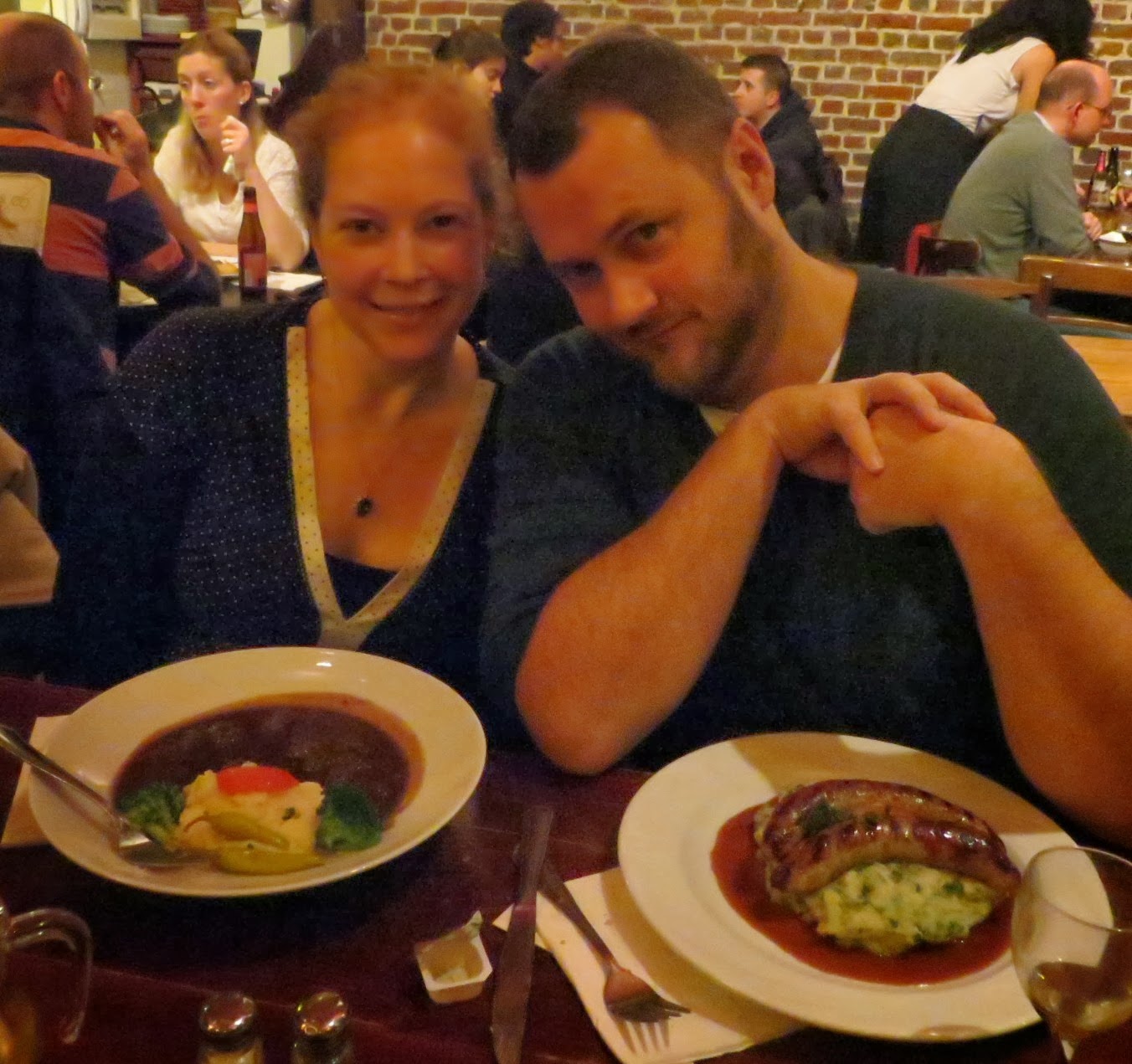
 Just two crazy kids, enjoying some traditional Belgian food.


Oh, shit...I forgot to mention the cookies.

*The average Belgian also eats about 15 pounds of chocolate per year--compared to the average American's consumption of only 11 pounds. But after eating their chocolate, I don't blame them at all.

Thursday, November 14, 2013

Brussels' Upper Town: Where the Fancy French People Lived

In the previous post, we covered the sites of Brussels' Lower Town. But what about the Upper Town?

Unlike the twisty cobbled medieval streets of the Lower Town, the Upper Town has more of a planned feel with wide streets more conducive to strolling and driving. After Belgium became independent in 1830, it became the financial center of Europe (with the first bank!) and power was held in the hands of the small French-speaking elite. As money poured into the city, the liberal city administration created the Upper Town as a modern capital city with "broad avenues and majestic buildings." The planners dreamed of designing an ideal city and the spirit of optimism was reflected in Belgium hosting seven world fairs before the outbreak of WWI. Basically, the Upper Town was a reflection of the changing times and the burgeoning consumer society. *

Despite all this talk of modernism, the Upper Town is still a mix of old and new. It's full of grand parks and art nouveau buildings, but is also home to a large gothic cathedral and royal palace. And just past that are modern office and apartment buildings and the home of the European Union. The Upper Town is kind of schizophrenic that way--but I like it because there is always something different to look at. 

A remnant of Brussels' 13th century original town wall is surrounded by modern construction scaffolding. Somehow it seems symbolically appropriate.

Climbing up the hill from the Lower Town to the Upper yields spectacular views. The large spire in the background is of the Town Hall in the Grand Place.

The first thing you notice in the Upper Town is the Royal Palace, used as the office of the current King, Albert II. The royal family actually lives in another palace a few miles out of town. The King is largely a figure-head but is seen as a common bond between Belgium's bickering Flemish and Walloon citizens (the country is divided into three regions: French-speaking Wallonia, Flemish/Dutch-speaking Flanders, and a small German-speaking community). The palace was not open to visitors when I was there, but its outside is certainly impressive. 
The Palais Royale.

Me and Jonathan outside the Palace.

Across the Royal Palace is the Parc de Bruxelles. I managed to haul myself out of bed two freezing mornings to run in the park (it has about a .75 mile loop). The park was created in 1776 by the Habsburg empress, Maria Theresa of Austria, when she ruled, but never actually visited, Brussels. The Parc de Bruxelles was also the site of the first conflict between the Belgian patriots and the troops of the Dutch King in 1830, right before the country won its independence. My guidebook describes the revolution as "almost bloodless." Tell that to the peeps who died here though, right?


Attached to the Royal Palace is a really interesting museum chronicling Belgian history, the BELvue Museum. It covers two floors and outlines the history of Belgium using documents, photographs, and other primary sources. Each of the museum's nine rooms covers a specific time period and the exhibits are all numbered. Upon arrival, you are handed a large pamphlet that includes descriptions and context for each exhibit. I wasn't sure what to expect--but darn if the whole thing wasn't actually fascinating. Especially the darker periods of Belgium's history, such as the atrocities committed in the Belgian Congo (as part of the rubber, ivory, and chocolate trades) and the cooperation of many Belgians with the Germans during WWI and WWII.

The entrance to the BELvue Museum. 


In one of the museum's rooms, holding the brochure and moving through the exhibits.

If you walk around the corner from the Royal Palace and down the Rue de la Regence, there are a couple of neat things to see including....


A public sculpture garden, the Place du Petit Sablon, with a beautiful fountain which is located across the street from....


Notre-Dame du Sablon Church. It's a 14th century gothic Catholic church that stands at the top of the Grand Sablon (remember, that's where I scored all that yummy chocolate a few days earlier). I went inside, but Mass was in progress since it was a Sunday so I just quietly observed from the back for a while. 

At the end of the street you come to the Place Poelart, which is a beautiful overlook point for the Lower Town part of the city. It's 200 feet above the former Senne River Valley and on a clear day (like I had) you can see all the way to The Atomium, built for the 1958 World's Fair to commemorate the dawn of the nuclear era. 


At the end of the Place Poelart is an elevator that can take you down to the Marroles neighborhood that has a pretty rockin flea market. It was unfortunately raining that morning (before I went for my Upper Town walk) so I didn't make it to the market, but you have to leave some things for next time, right?

At this point in my walk, I made my way back down to the Grand Sablon and might have stopped into another chocolate shop to try the wares (that might or might not have been Frederic Blondeel). Instead of pulling out the map, I decided to just walk down some new streets and find my way back to the apartment. Part of the fun of wandering a new city is the wandering. I knew the general direction I needed to head in, and the spire from the Town Hall in the Grand Place makes for a really good landmark. I didn't have any trouble finding my way back (though I take a bit of circuitous route) and ended up getting home just before the afternoon rain hit.

*Most of this information comes from the guidebook provided by the BELvue Museum which explains Belgium's belle epoque.

Coming up next: my visit to the EU and notes on Belgium's cuisine (and yes, there is more to Belgian food than chocolate and waffles).